


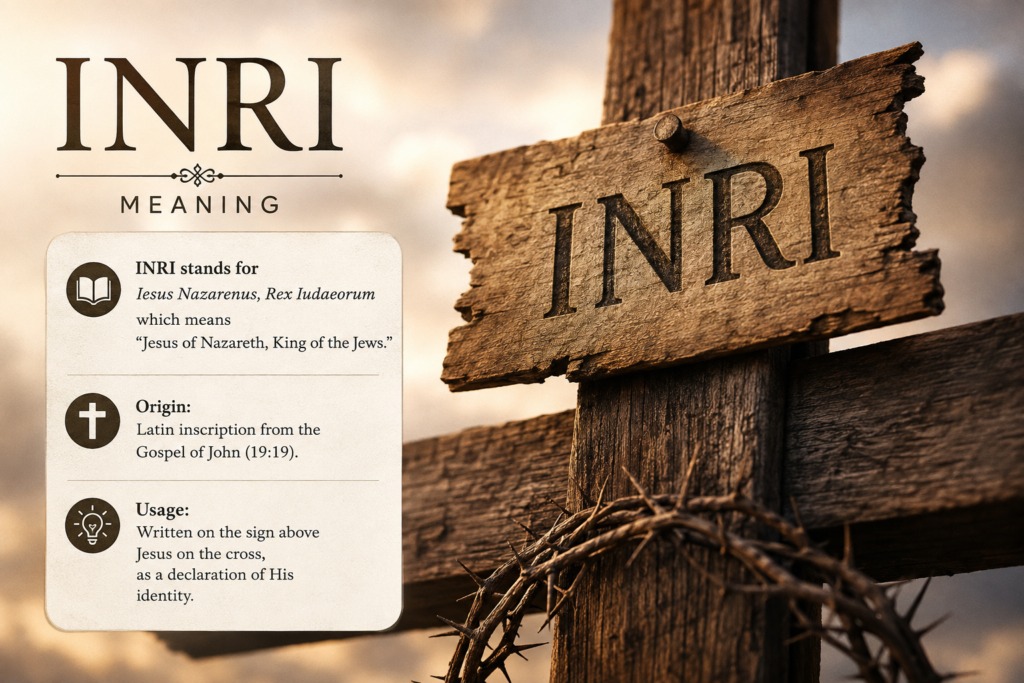
INRI is a Latin acronym that stands for Iesus Nazarenus, Rex Iudaeorum, which translates to “Jesus of Nazareth, King of the Jews.” According to the Christian New Testament, this inscription was placed on a wooden sign above Jesus’ head during his crucifixion by order of Pontius Pilate as an official declaration of his charge.
Here is what most people miss: dictionary entries tell you the Latin translation, but they gloss over why these four letters appear on millions of crucifixes, religious artworks, tattoos, and pop culture references worldwide. Understanding INRI requires looking at both its sacred history and its modern cultural representations.
1. Core Meaning & Literal Usage
The letters INRI represent an initialism of four specific Latin words carved onto the titulus crucis (crucifixion title card):
- I = Iesus (Jesus)
- N = Nazarenus (of Nazareth)
- R = Rex (King)
- I = Iudaeorum (of the Jews)
In classical Latin script, the letter “I” served as both the vowel /i/ and the consonant sound now written as “J”. That is why Iesus and Iudaeorum start with an “I” rather than a “J”.
Sentence Examples:
- Art History: “The painter inscribed the letters INRI on a small parchment plaque fixed to the top of the wooden cross.”
- Religious Studies: “Pilate ordered the inscription INRI to be displayed publicly in Latin, Greek, and Hebrew.”
2. Biblical Context & The Three Languages
According to the Gospel of John (John 19:19–20), Pontius Pilate wrote the notice and had it affixed to the cross. Crucially, the text was not written in Latin alone—it appeared in three major regional languages:
- Hebrew (or Aramaic): For the local Jewish population in Jerusalem.
- Latin: The official bureaucratic language of the ruling Roman Empire.
- Greek: The widely spoken lingua franca of the Eastern Mediterranean region.
Why Latin Stuck: As Western Christianity developed through the Roman Catholic Church, the Latin abbreviation INRI became the standard artistic shorthand used across European paintings, sculptures, and crucifixes.
3. Cultural Nuances, Tattoos, and Pop Culture Connections
Beyond traditional religious iconography, INRI appears across several modern cultural mediums:
- Religious Tattoos: Many people get INRI tattooed alongside a cross, crown of thorns, or sacred heart as a deeply personal symbol of faith, endurance, or sacrifice.
- Classical & Sacred Art: Renaissance masters like Michelangelo, Caravaggio, and Rembrandt consistently featured the INRI sign atop their depictions of the Crucifixion.
- Music & Media: The acronym is frequently referenced in metal bands, film sets, and gothic fashion as a symbol of sacrifice or dramatic religious motif.

4. Entity Mapping & Context Comparison Table
To assist search engines and readers in distinguishing INRI from other religious abbreviations, here is how related entities map out:
| Acronym / Term | Full Expansion | Language | Primary Domain | Core Symbolism |
| INRI | Iesus Nazarenus, Rex Iudaeorum | Latin | Christian Iconography | “Jesus of Nazareth, King of the Jews” |
| IHS | Iesus Hominum Salvator / Monogram | Greek / Latin | Christogram | “Jesus, Savior of Men” / Name of Jesus |
| Chi-Ro ($\mathbf{\chi\rho}$) | Christos ($\text{XPI\Sigma TO\Sigma}$) | Greek | Early Christian Symbol | First two letters of “Christ” in Greek |
| Alpha & Omega | $\text{A}$ and $\mathbf{\Omega}$ | Greek | Biblical Metaphor | “The Beginning and the End” |
| INRJ | Variant with Modern ‘J’ | Latin / English | Contemporary Art | Identical to INRI (Iesus Nazarenus Rex Judaeorum) |
5. Mistakes & Misunderstandings to Avoid
- Thinking INRI is a Secret Code: It is not an esoteric cipher; it is simply a direct Latin initialism of a historical Roman charge.
- Assuming ‘J’ Was Missing by Mistake: Ancient Latin did not possess the letter “J”. Writing Iesus instead of Jesus is historically and linguistically correct for Roman Latin.
- Confusing INRI with IHS: INRI specifically relates to the Crucifixion notice, while IHS is a monogram representing the name of Jesus used in church emblems and vestments.
6. Frequently Asked Questions (GEO / Q&A Block)
What does INRI mean in English?
INRI translates to “Jesus of Nazareth, King of the Jews” in English (Iesus Nazarenus, Rex Iudaeorum in Latin).
Why is INRI on the cross?
According to biblical accounts, Pontius Pilate ordered the title posted on the cross to publicly state the official crime or accusation against Jesus during his execution.
What language is INRI written in?
INRI is an abbreviation of Latin words. However, gospel accounts note that the original title above Jesus was written in three languages: Hebrew, Latin, and Greek.
The One Rule That Unlocks the Meaning of INRI
To remember what INRI stands for without getting lost in historical translations, use this simple formula:
Whenever you see those four letters atop a cross or in an artwork, remember that each letter represents one Latin word describing Jesus’ identity and title. Straightforward. No confusion there.
