


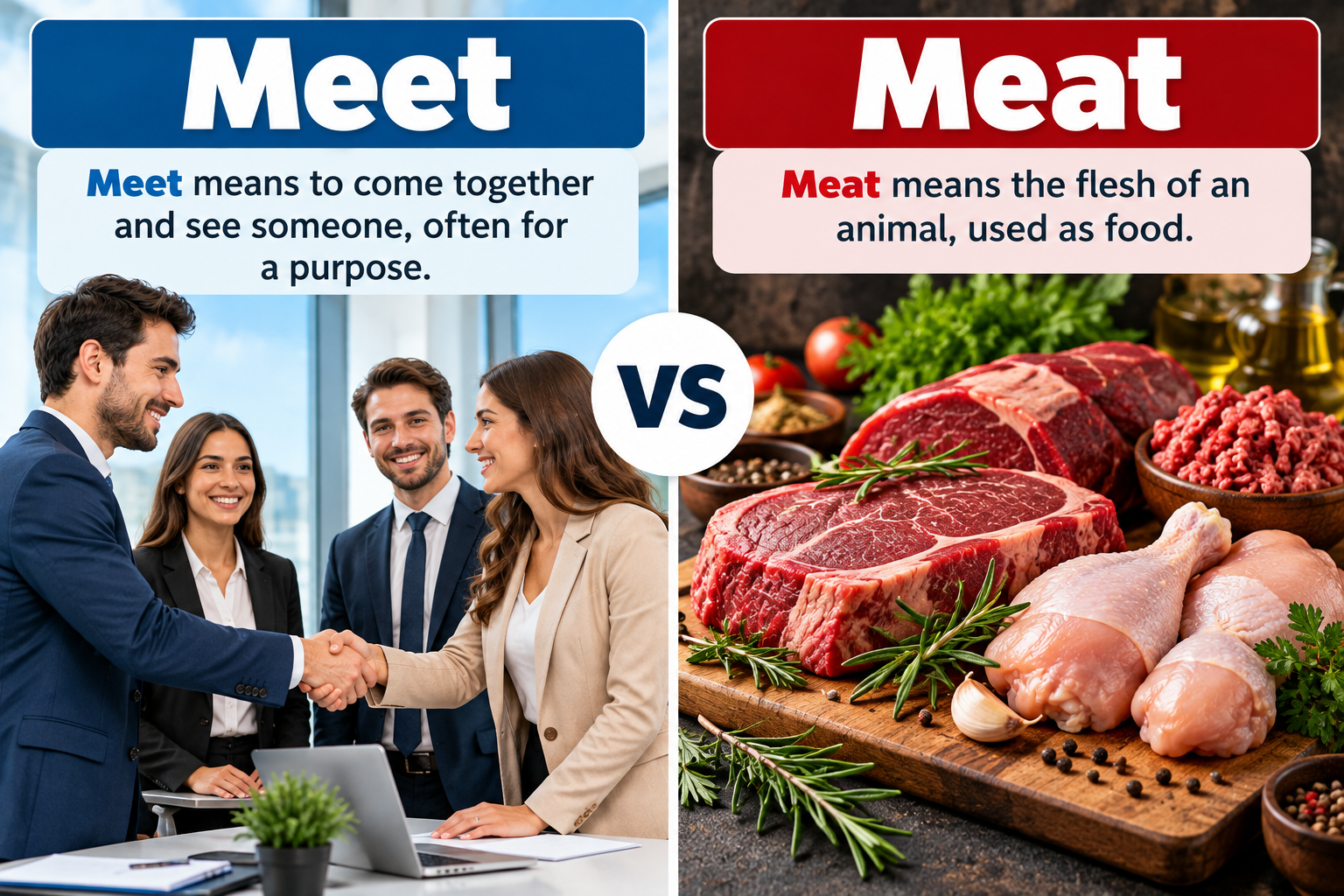
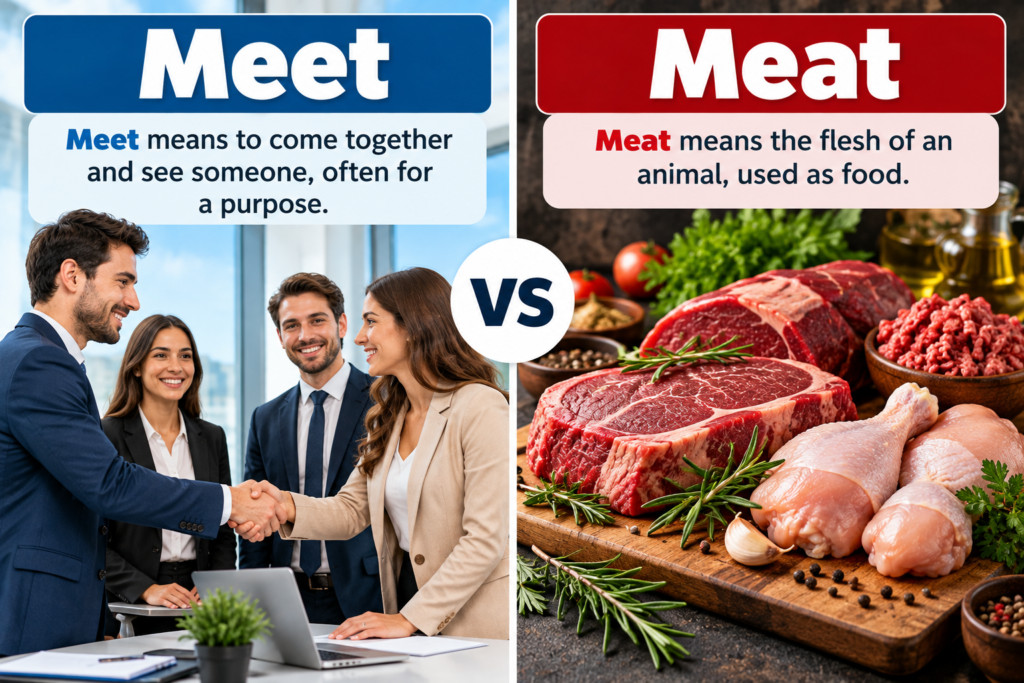
Meet refers to connection, community, and gathering, while meat signifies substance, essential core, and physical nourishment. Choosing between these homophones comes down to whether your brand’s core offer centers on interpersonal engagement or physical, tangible value.
Most founders treat homophone brand names like a simple spelling test. That is a mistake. Selecting between sound-alike words requires evaluating domain availability, phonetic search friction, and linguistic positioning so your audience lands on your digital doorstep every time.
Here’s how to strategically evaluate homophones, choose the right semantic direction, and build a brand name that ranks and converts.
The Strategic Difference: Meet vs. Meat
To build an memorable entity, you must align the word’s underlying psychological triggers with your offer.
- Meet (Verb/Noun): Triggers feelings of collaboration, digital hubs, networking, and human warmth. It is active, forward-looking, and intrinsically social.
- Meat (Noun): Triggers imagery of substance, depth, protein, craftsmanship, and raw strength. Beyond literal food products, it implies the “meat of the matter”—the essential value proposition.
Categorized Name Concepts for Modern Brands
When picking a name built around these root sounds, clarity of positioning determines your brand equity.
1. Modern & Tech-Forward
- MeetGrid | Connected Networks | Best for B2B SaaS, event platforms, and networking apps.
- Meatless Lab | Clean Innovation | Best for food-tech, plant-based alternative brands, and sustainable bio-labs.
- MeetPulse | Live Engagement | Best for community management platforms and real-time collaboration tools.
2. Aesthetic & Minimalist
- Mete Studio | Subtle Elevation | Best for design agencies, high-end apparel, and creative consultancies.
- The Meat Craft | Artisanal Quality | Best for premium butcher shops, direct-to-consumer delivery, and culinary brands.
- Meetroom | Focused Space | Best for co-working venues, virtual event studios, and masterminds.
3. High-Impact & Catchy
- MeatHead Media | Unapologetic Depth | Best for fitness content, podcasts, and direct-response marketing agencies.
- MeetLogic | Smart Connections | Best for match-making algorithms, recruiting tech, and CRM systems.
- Meat & Main | Grounded Core | Best for modern steakhouses, hospitality groups, and brick-and-mortar retail.
Linguistic & Naming Psychology Breakdown
Homophones create what linguists call phonetic ambiguity. When someone hears your name spoken on a podcast or verbal referral, their brain defaults to the most common contextual meaning unless engineered otherwise.
Names utilizing the /miːt/ sound benefit from high front vowels. The long “e” sound communicates speed, precision, and modern energy.
When leveraging the sound in digital marketing, consider the search engine behavior:
<!-- STEP 1 -->
<div class="acf-step audio-step">
  <div class="acf-icon">🎧</div>
  <div class="acf-content">
    <span class="acf-label">Audio Perception</span>
    <strong>/miːt/</strong>
    <small>Sound is perceived first</small>
  </div>
</div>

<div class="acf-arrow">→</div>

<!-- STEP 2 -->
<div class="acf-step context-step">
  <div class="acf-icon">🧠</div>
  <div class="acf-content">
    <span class="acf-label">Context Clues</span>
    <strong>Tech vs. Food</strong>
    <small>Meaning is identified from context</small>
  </div>
</div>

<div class="acf-arrow">→</div>

<!-- STEP 3 -->
<div class="acf-step search-step">
  <div class="acf-icon">🔎</div>
  <div class="acf-content">
    <span class="acf-label">Search Engine Query</span>
    <strong>Find the intended meaning</strong>
    <small>Context guides the search</small>
  </div>
</div>
<div class="acf-example tech-example">
<span class="example-icon">💻</span>
<div>
<strong>Tech Context</strong>
<p>“Meet the new AI assistant.”</p>
<small>→ Search intent: meeting / introduction</small>
</div>
</div>
<div class="acf-example food-example">
<span class="example-icon">🍖</span>
<div>
<strong>Food Context</strong>
<p>“The meat is ready to cook.”</p>
<small>→ Search intent: food / animal flesh</small>
</div>
</div>If your platform is named “Meat” but deals in corporate software, you create cognitive dissonance. Audiences expect the literal spelling to match the industry vertical.
Brand Positioning Matrix
| Brand Concept | Core Meaning & Vibe | Ideal Industry Fit | Phonetic Friction |
| MeetFlow | Seamless connection and interaction | Event Tech, SaaS | Low |
| MeatCrafter | Precision, quality substance, craft | DTC Food, Culinary | Low |
| Meeter | Casual, direct peer-to-peer gathering | Mobile Social Apps | Medium (Spelling confusion) |
| Meat & Bone | Raw essence, fundamental strength | Fitness, Male Grooming | Low |
Common Pitfalls When Selecting Homophone Names
- Voice Search Friction: Alexa and Google Assistant struggle with homophones. If you name your app “Meat Up,” voice engines will likely parse it as “Meet Up.”
- Trademark Bottlenecks: Highly common dictionary words are difficult to defend unless paired with a distinctive second element (e.g., “Meetup” vs. just “Meet”).
- Domain Hoops: The exact match .com for single dictionary terms like Meet or Meat carries six-figure price tags, forcing brands into sub-optimal TLDs or added modifier words.
- Pivoting Limits: Naming your brand “Meat Box” limits your product lines if you ever expand into non-meat protein or general culinary goods.
Strategic Selection Framework
To validate your choice before securing assets, run your candidate name through this 4-step filter:
- The Radio Test: Say out loud: “Go to [Name].com.” Does the listener know immediately how to spell it without you saying “meat with an EA”?
- The SERP Cleanliness Check: Search the target name on Google. Are you competing against massive established entities or direct dictionary definitions?
- The Entity Disambiguation Test: Search the term alongside your target industry (e.g., “Meet logistics”). Check if Google automatically alters the query spelling.
- Trademark Class Screening: Check the USPTO database for registered marks in Class 009 (Software/Tech) for “Meet” variants or Class 029 (Food Products) for “Meat” variants.
Frequently Asked Questions
Which spelling is better for a community or software brand?
“Meet” is the clear strategic choice for community, software, and networking platforms. It directly signals human connection, gathering, and collaboration, minimizing friction in user onboarding.
How do you handle search engine confusion with homophones?
Optimize your primary brand entities using clear structured data (Schema.org), tight topic clusters, and explicit category modifiers in title tags (e.g., “Meat Crafter | Artisanal Grass-Fed Beef”).
Should I buy both domain spellings?
Yes. If your budget allows, buying both variants (e.g., meetbrand.com and meatbrand.com) and 301-redirecting the secondary domain prevents competitor squatting and captures misdirected traffic.
The 1-Rule Golden Takeaway
Match the spelling to the primary sensory promise of your product: use Meet when your value proposition lies in the human connection between people, and use Meat when your product centers on tangible substance and physical core quality.
